
 русский
 عربى
عربى
 Tiếng Việt
Professional painting line specially designed for grain tank truck body manufacturing and refurbishment, applicable to various grain tank truck types (grain transport tank truck, bulk grain tank truck...
See Details
Yueze Environmental Protection provides one-stop compliant industrial surface treatment solutions with professional tech and fine craftsmanship.
 Get Inquiries
2026-09-11
Content
The auto body spray booth controls the two things that decide whether a paint job passes or fails: air movement and contamination control. If you buy a booth with the wrong airflow pattern or filter rating, you will see the result in orange peel, dust spots, and wasted paint. The right booth, by contrast, lets you run a predictable cycle time from a clean surface to a cured finish.
For a typical car body, the booth must remove overspray and solvent vapor without creating turbulence that breaks the paint film. That means you need to look at crossdraft versus downdraft airflow, filter efficiency, and the ability to maintain a stable temperature before coating. The practical impact is on uptime, rework cost, and the final gloss level of the body.
Booth type selection depends on the size of the workpieces, the daily volume, and how much automation your line already has. The table below gives a quick comparison of the four most common layouts for automotive body painting.
| Booth Type | Best For | Typical Airflow | Key Trade-off |
|---|---|---|---|
| Automatic robotic spray booth | High-volume body lines | Downdraft, 0.4–0.6 m/s | Higher upfront cost, needs programming |
| Manual side-wall booth | Small batches and touch-up | Crossdraft, 0.5–0.7 m/s | More operator-dependent |
| Heavy vehicle spray booth | Truck cabs, vans, bus bodies | Downdraft with larger cross-section | Large floor area and heating demand |
| Retractable mobile booth | Occasional oversized parts | Open-front, around 0.5 m/s | Less contamination control |
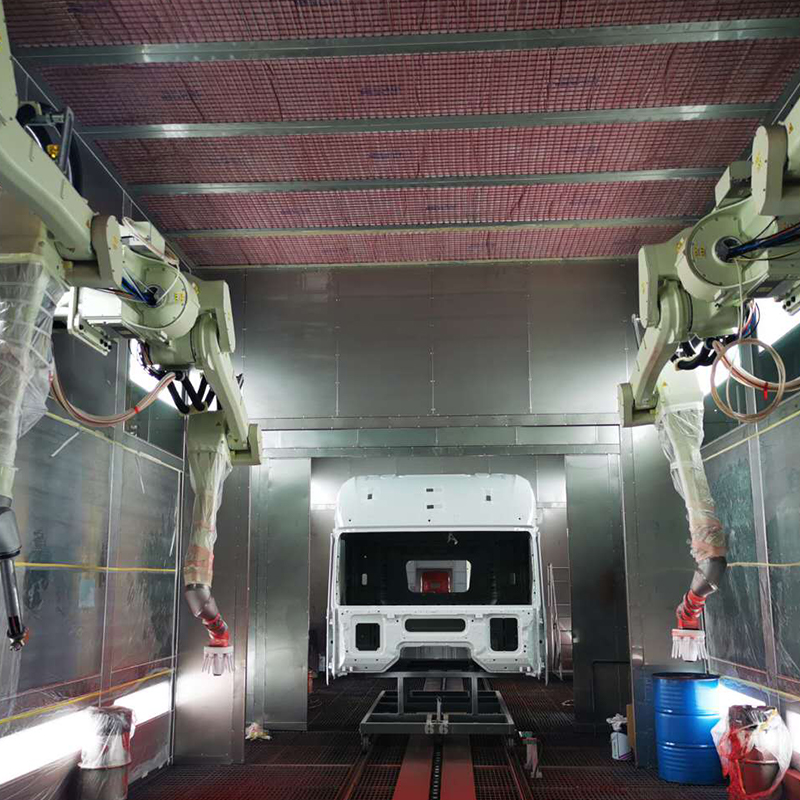
For high-volume car body lines, an automatic robotic spray booth provides repeatable film build and faster transitions. It also lets you program the gun path to match complex body shapes.
 Automatic Robotic Spray Booth for High-Volume Automotive LinesThis booth uses programmable robots for consistent coating on complex car bodies, supporting continuous production and high material efficiency. It is ideal for mass production where repeatable film build and faster transitions are needed.View Product →
On the other hand, a manually operated side-wall booth gives the operator better control for small runs, but you lose repeatability from one body to the next.
No two car body lines are identical, but a few numbers separate a good booth from a bad investment. Look for these five performance points before you sign a purchase order.
These specifications affect more than your daily operations. They also change how easily you can certify your emission performance and how much filter replacement costs over the booth's lifetime.
Production volume determines the level of automation, while the workpiece mix determines the booth size and color-change system. If you produce a single model continuously, a fixed automatic booth is the best choice. If you switch between models daily, you need a booth with quick color changes and easy access.
When a line carries several body variants plus sanding work, a custom spray booth and sanding booth is more practical than a standard catalog booth. It lets you place the roof and floor outlets exactly where your conveyor and operators need them.
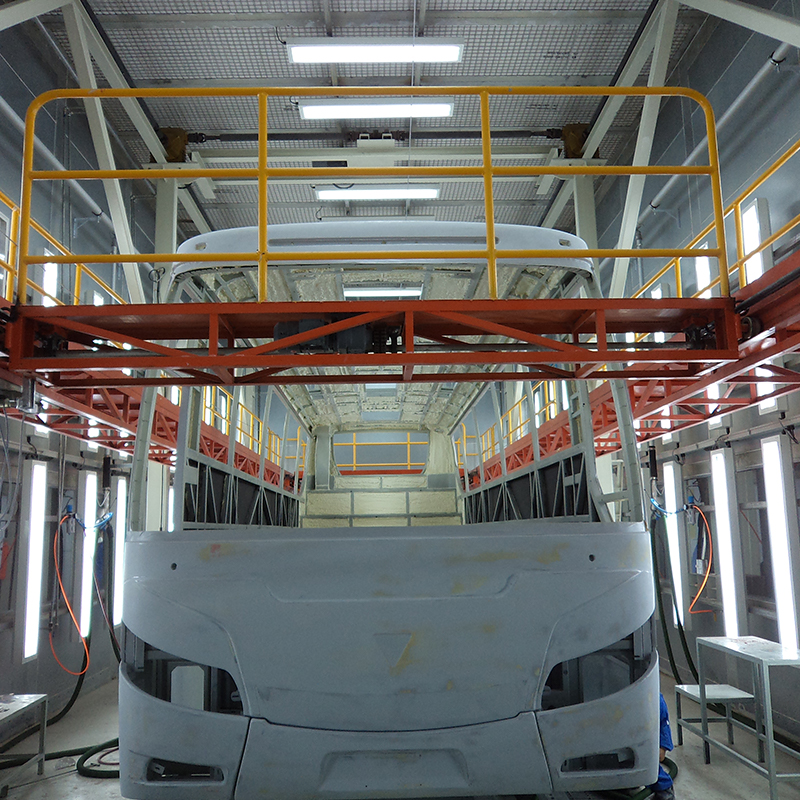 Custom Retractable Spray and Sanding Booth for Flexible OperationsThis movable booth combines spraying and sanding in one retractable unit, saving space and adapting to multiple stations. Its design suits lines with several body variants and enables precise placement of outlets.View Product →
The most common purchasing risk is buying a booth that fits today's body size but cannot handle a future model. Leave at least 300 mm of clearance around your largest workpiece for operator movement and future tooling.
A booth is never an island. It has to talk to the conveyor that moves bodies in and out, the sanding or blasting room that prepares surfaces, the drying room that follows coating, and the waste gas treatment unit that handles solvent-laden air. If you skip the interface design, you can end up with body-in-hooks that snag on the booth doors or an exhaust stack that cannot keep up with the spray volume.
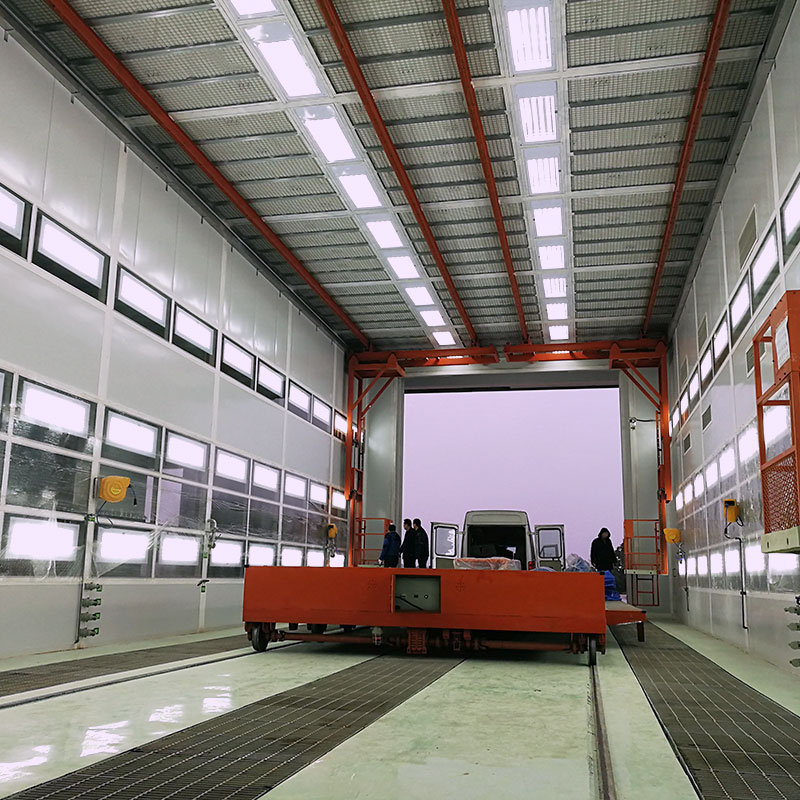
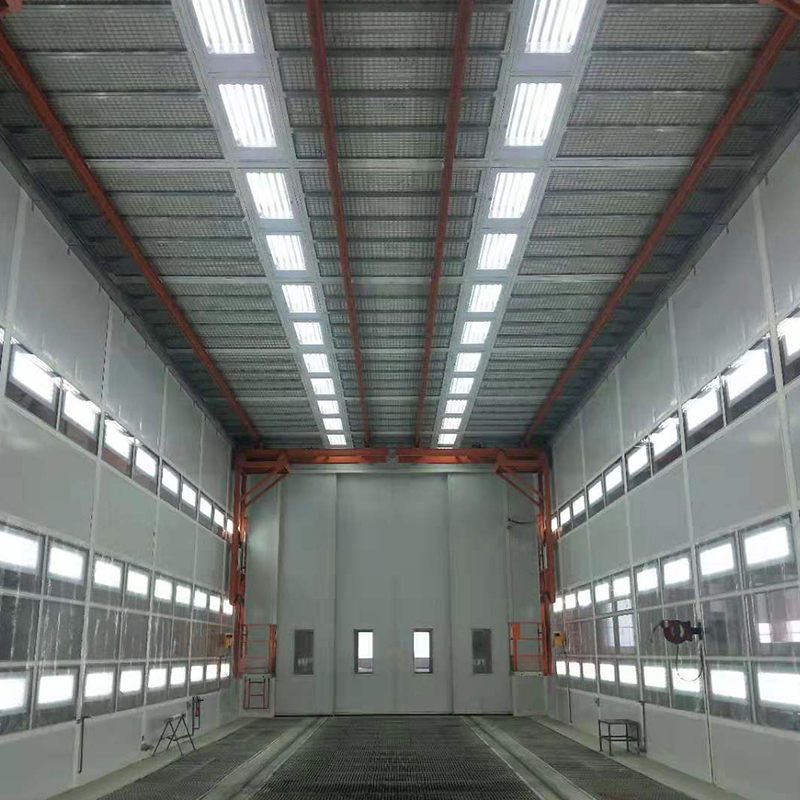
For a full automotive finishing layout, automotive and EV manufacturing solutions cover everything from pretreatment to curing. When you also handle heavy vehicles, the booth needs a considerably larger floor cross-section and a reinforced exhaust path. A dedicated heavy vehicle spray booth is designed for that scale.
 Heavy Vehicle Spray Booth for Large Equipment PaintingThis booth handles oversized vehicles like trucks and buses, offering integrated spray and cure functions with strong airflow and temperature control. It provides a durable solution for heavy industrial coating needs.View Product →
This integration also means you need to plan for waste gas treatment and filter disposal, not just the booth itself. To get a clearer picture of how the pieces fit together, review what equipment a coating production line has.
A booth manufacturer with real process experience can make a big difference when you are commissioning the line. Ask for detailed airflow simulation, filter sizing, and a clear noise specification. A reliable supplier should also tell you how the booth behaves with the specific paint you plan to use, not just with a generic airflow number.
Look for a partner that can manufacture the booth in-house. A factory with 35,000 m² of manufacturing space and a track record of building complete coating lines has the flexibility to form the booth panels, weld the rigging, and test the filtration before shipping. That avoids the loose-engineering risks that come from buying a booth and a conveyor from separate companies.
Above all, the supplier should be able to give you a clear picture of commissioning time. A hundred or two hundred square meters of booth area can sit idle if the air balance and damper settings are not tuned on site. Insist on a defined start-up procedure and a written guarantee for airflow velocity, filter efficiency, and noise level.
Professional painting line specially designed for grain tank truck body manufacturing and refurbishment, applicable to various grain tank truck types (grain transport tank truck, bulk grain tank truck...
See Details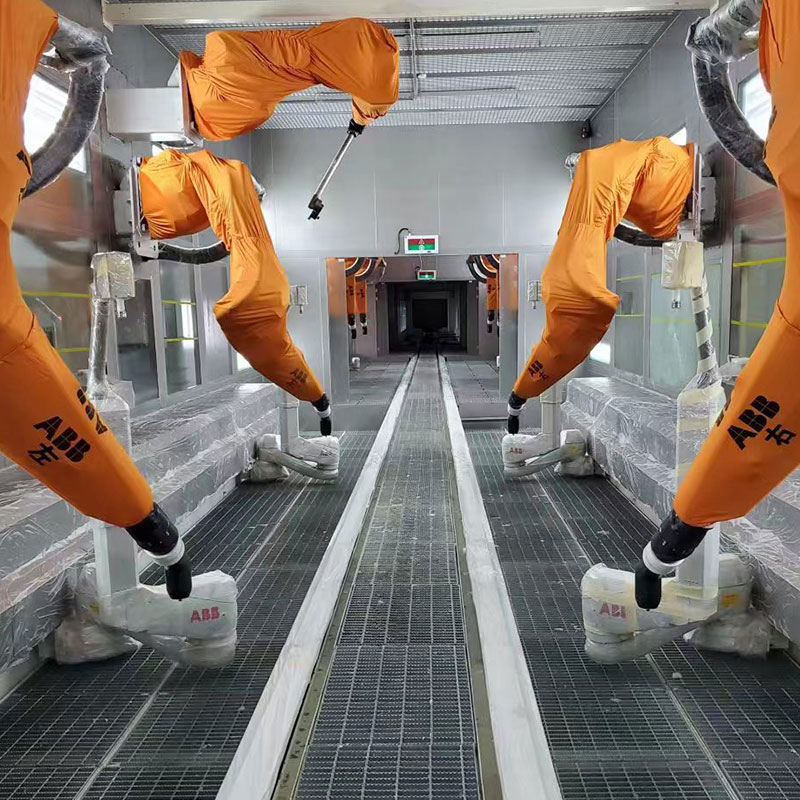
An automatic robotic spray booth is an intelligent, unmanned coating system. Equipped with a robot spraying system, constant temperature air circulation, and a high-efficiency exhaust filtration syste...
See Details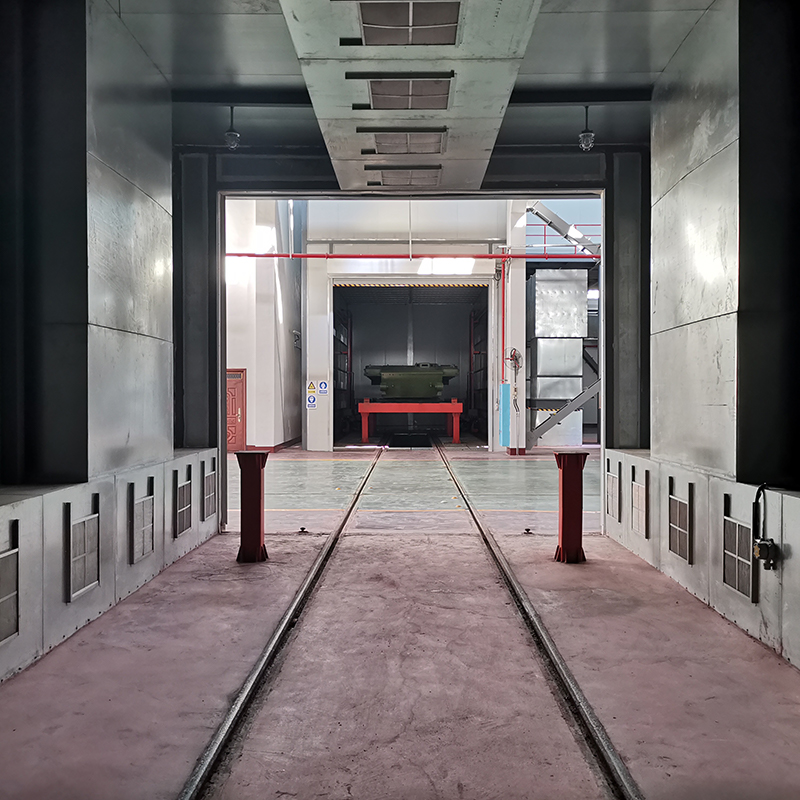
The spray paint line is a complete automated coating system, including spraying, drying, curing, and conveying processes. It features stable operation, uniform spraying effect, and good sealing perfor...
See Details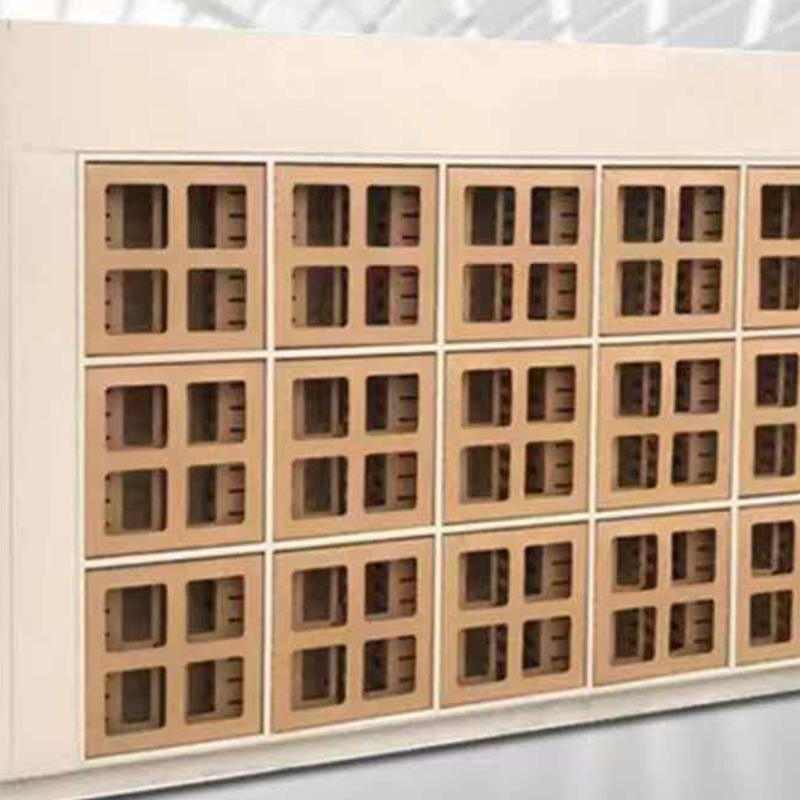
Cardboard Paint Arresto is professional equipment for capturing and filtering paint mist, mainly made of high-quality corrugated cardboard, filter cotton, and waterproof coating. It adopts a modular d...
See Details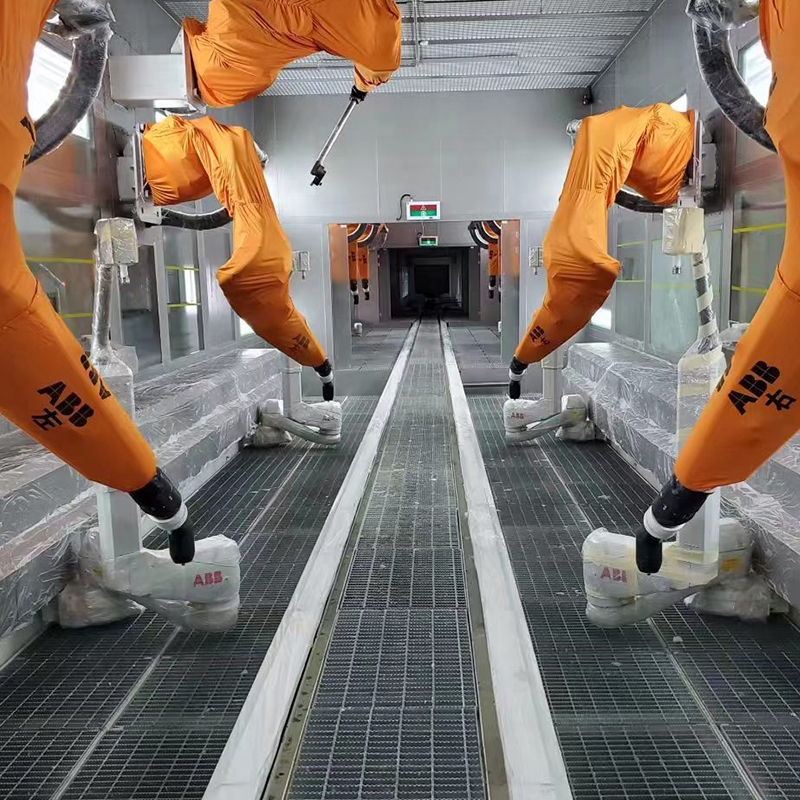
Professional spray coating line specially designed for motor casings, applicable to various motor casing types (electric vehicle motor casing, industrial motor casing, household motor casing, high-tem...
See Details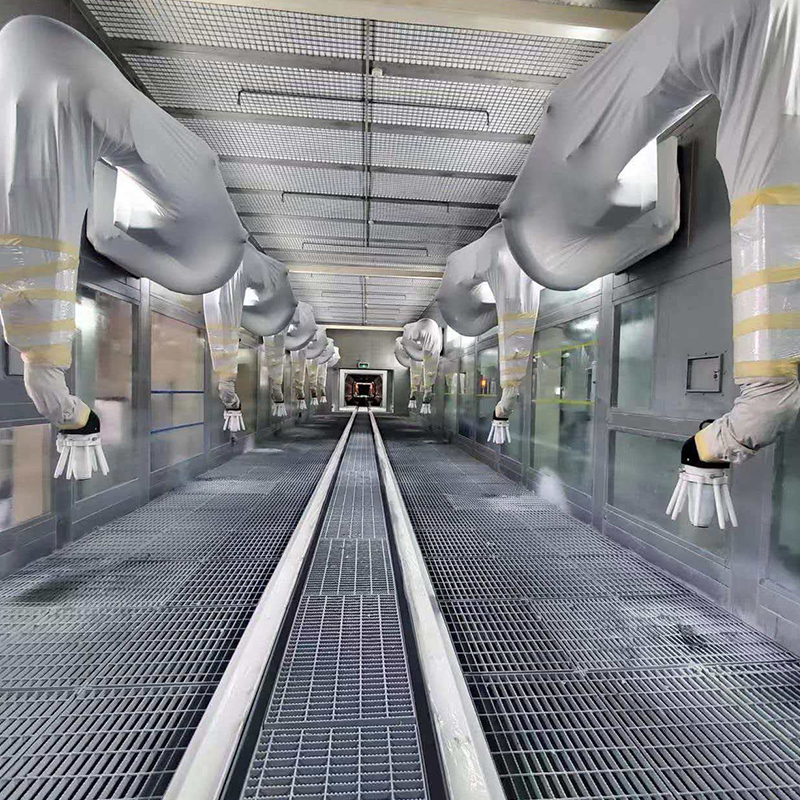
Professional spray coating line specially designed for car wheel manufacturing and refurbishment, applicable to various car wheel types (steel wheel, aluminum alloy wheel, forged wheel, cast wheel, pa...
See DetailsBuild Your Customized Industrial Coating System
Send us your workpiece information, production capacity, coating process, workshop layout, and environmental requirements. Yueze will help evaluate your project and develop a suitable coating, conveying, drying, and environmental treatment solution.
Main menu
Products
Contact Us
Company Address:
No. 12, Park Avenue, Shanggang Industrial Park, Jianhu, Yancheng City, Jiangsu Province
Message Us Right Now!

Follow us: